More than the past 150 years, as Toronto has developed into the fiscal and industrialized center of Canada, it has been the hub of several broad improvements to its haulage system. It also has been the home of frequent innovations in transportation, covering the whole range of amenities from infrastructure and freeways to computerized traffic control, passage, regional rail, airports, and bicycle facilities. Commonly, Toronto's road system follows a network pattern.
Notable roads include Yonge Street, the greatest avenue in the world; Prince Edward (Bloor Street) Viaduct, an exceptional instance of foresight and scheduling; Gardiner Expressway along the city's waterfront; Highway 401, the key profitable and traveler link crosswise Toronto; and Queen Elizabeth Way, the first superhighway in North America.
The full of activity junction of Bloor Street and Yonge Street was home to Toronto's first traffic signal in 1925. Today's included Traffic Control Centre combines the operation of a passageway system with a traffic indication control system and was installed in 1989.
A permit to run public transportation in Toronto was settled to the Toronto Street Railway Company in 1861.
The idea of a subway was originally recommended in 1910, but it took pending 1949 before digging started on the 7.4-km Yonge subway, which opened in 1954.
Today, the city's streetcar network continues to be one of the prime and mainly vigorous in North America. The Toronto Transportation Commission has been affirmed a "transportation showcase" and continues to enlarge its character worldwide.
The GO transport commuter train is only one of its kind heavy rail system ration the industry district in downtown Toronto with double-decker heavy rail train cars.
Malton Airport, later renamed Toronto International, and currently called Pearson International, opened in August 1938.
It currently has three terminals with a total of 124 gates, together with the Trillium Terminal 3, which was confidentially built and opened in 1991.
Toronto was rated the number one cycling city in North America in December 1995 and has a inclusive provincial domain system of over 4,600, which contains more than 80 km of trails competent of helpful pedestrians and cyclists.
The name of a god of fire in Roman tradition. The word volcano is consequential from the surname of Vulcano, a volcanic island in the Aeolian Islands of Italy whose name in turn originates from Vulcan, The study of volcanoes is called volcanology, occasionally spelled vulcanology.
Volcanoes are usually establish where tectonic plates are diverging or converging. A mid-oceanic ridge, for case the Mid-Atlantic Ridge, has examples of volcanoes caused by divergent tectonic plates pulling separately; the Pacific Ring of Fire has examples of volcanoes caused by convergent tectonic plates pending jointly.
By difference, volcanoes are usually not shaped anywhere two tectonic plates slide past one another. Volcanoes can also form where there is stretching and tapering of the Earth's coating in the interiors of plates, e.g., in the East African Rift, the Wells Gray-Clearwater volcanic field and the Rio Grande Rift in North America. This type of volcanism cascade under the sunshade of "Plate hypothesis" volcanism.
Interrupt volcanism has also been assume to be caused by layer plumes. These so-called "hotspots", for instance Hawaii, are postulated to begin from flow diapirs from the core-mantle state line, 3,000 km cavernous in the ground.
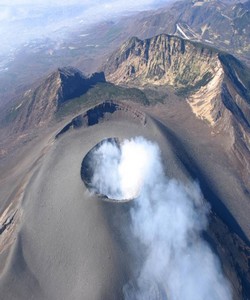
A volcano is a gap, or break, in a planet's exterior or scab, which allows hot molten rock, volcanic ash and gases to flee from under the surface.